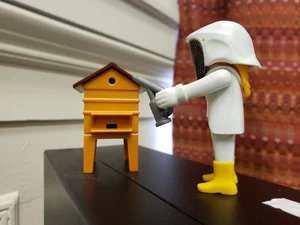
Now in our 7th year, we have confirmed our commitment to community science, pollinator protection, and education. The launch of the Cincinnati Urban Ecology Study (CUES) marked the start of more big ideas for QCPP, including our plan to create the Cincinnati Urban Ecology Institute, a new QCPP program that will support high school and college students in urban ecology and sustainability research through paid research opportunities, co-ops, and professional development.
This year, we delivered on our promise to run a successful pilot project that showed we are ready to build the Institute. We also added new board members to improve our internal controls, managed our beehives at UrbanStead Cheese and the Cincinnati Art Museum (CAM), presented at the local park events and festivals, continued the Wyoming North Park Pollinator Garden Project, and delivered bees for a CAM-commissioned artistic project.
We are gearing up for a fantastic 2027, knowing that the first year of any new project is the building year. The second year is the growing phase, and the third year is when it blooms!
Our partnerships grew this year, as did our exposure on iNaturalist. Congratulations to Board Member Kyle Williams, who was designated an iNaturalist Ambassador for uploading over 1000 different species to the database, and to several of our project sites, which received “research quality” status with the data our CUES participants contributed.
QCPP could not have delivered on this work without raising just over $11,000 from our donors this past year. We keep our costs low and operate with approximately $15,000 or less in expenses every year. In 2025, we moved our headquarters to the Cardinal Land Conservancy property, co-habiting with Adventure Crew at the Marshall Ave. campus, where we are partnering with those organizations and the Civic Garden Center to build an amazing outdoor education campus.
Under the stewardship of Anne Chasser, our current board president, and with a generous donation of his garden from Dan Druffel for our May event, along with support from many others who supported our spring fundraiser, we were able to pay all our student scientists this summer. Roads, River, and Trails gave us a sizeable discount on water bottles, so we could also provide each researcher with their own water bottle, CUES-emblazoned T-shirt, and note-taking equipment.
QCPP presents the Cincinnati Urban Ecology Institute
This summer, a team of student researchers, led by Sylvana Ross, a QCPP board member and PhD candidate at Cornell University, collected data across 7 Cincinnati parks, studying two small but mighty groups of urban wildlife: pollinators and ants.
What the CUES crew found is already reshaping how we understand the health of our data collection sites, the surrounding city, and what Cincinnati has to share with scientists studying urban ecology worldwide.
CUES is the first of many projects the Institute will support, and we can’t wait to show you what comes next.
In November, Sylvana and several of her student researchers presented their results to an audience of 30 stakeholders, sharing details on each of the seven data collection sites and what they might mean for land managers considering pollinator-friendly environments. Thank you to Cincinnati State for hosting that hugely successful event.
OUR CUES Project by the Numbers
7 Cincinnati Parks/Greenspaces
12 CUES Team Members
ranging from rising 9th graders at Cincinnati Public Schools to graduating seniors from the University of Cincinnati and Ohio State.
Over 1000 Pollinators counted
57 Plant Species observed
876 iNaturalist Observations
258 NEW species added to iNaturalist